Caudal-HW
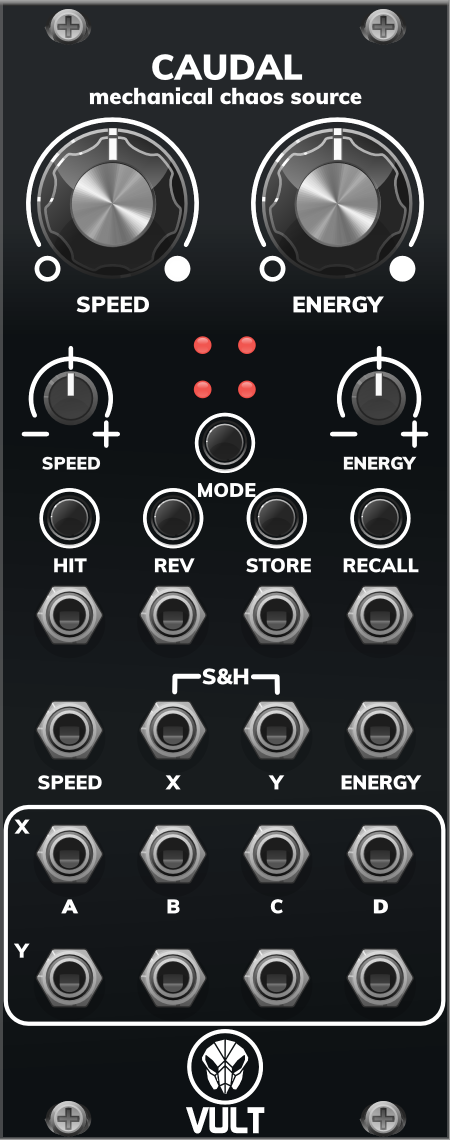
This version of Caudal is a clone of the actual hardware module. It simulates as close as possible all the aspects of the original hardware module: it is a simulator that runs the same code as the hardware module.
Like the original, it is a chaotic voltage source based on the simulation of a multi segment pendulum. The movement of the pendulum produces slowly evolving, interrelated voltages that never repeat exactly.
You can find the full manual in the main product page https://www.vult-dsp.com/caudal
Documentation
- Speed: defines how fast the pendulum swings.
- Energy: changes properties of the model such as gravity and mass, which makes the pendulum move more or less aggressively.
- Speed and Energy (small knobs): bipolar attenuverters for the corresponding CV inputs.
- Mode: cycles through the eight simulation models. The four LEDs above the button show which one is selected, and the model can also be picked directly from the right-click menu.
- Hit: sets a new initial position and new angular velocities. Triggered repeatedly it can make the pendulum rotate continuously.
- Rev: reverses the angular velocities, making every segment move in the opposite direction.
- Store: saves the current state of the pendulum.
- Recall: returns the pendulum to the stored state.
Each of the four buttons has a trigger input below it, so Hit, Rev, Store and Recall can all be driven from the patch.
Models
The hardware version carries five models beyond the three found in the software Caudal. All of them drive the same eight outputs, so changing model alters the character of the movement without changing how the module is patched.
- Pendula: the multi segment pendulum.
- Planets: bodies attracting each other through gravity, giving slower and wider orbits.
- Fish Tank: bodies bouncing around inside a container, giving nervous and irregular movement.
- Fluctuating Voltage
- Coupled Oscillators
- Feedback Dynamics
- Analog Shift Register
- Kicked Rotors
Inputs
- Speed and Energy: CV inputs, scaled by the small attenuverters.
- X and Y (S&H): clock inputs. When patched, the corresponding row of outputs is sampled and held on every clock pulse, which turns the continuous pendulum movement into stepped voltages.
Outputs
Two rows of four outputs, one per pendulum segment:
- X A-D: horizontal position of each segment.
- Y A-D: vertical position of each segment.
Videos
Help improve this manual here.